Welcome to Week 4 of National Safety Month 2025
Proudly Sponsored by:

At Southpac Aerospace, we’re proud to work alongside the operators who keep regional Australia connected. For more than 20 years, we’ve partnered with aviation businesses large and small to strengthen safety, enhance operational performance, and meet the unique demands of regional flight.
Our training and consulting services are designed for aviation professionals. From lead auditor qualifications and safety management system development to Aerodrome Reporting Officer and Works Safety Officer training, we equip teams with the skills and mindset to build a strong culture of safety and continuous improvement. Courses are delivered in-person or through live virtual classrooms, making them accessible wherever your operations are based.
Every course is grounded in global aviation standards but tailored to the realities of the regional environment. Our facilitators bring deep industry experience and practical insights, ensuring that what you learn can be applied immediately to your day-to-day operations.
Beyond training, Southpac Aerospace also provides audit, assurance, and consulting services. Whether you’re preparing for certification, refining your SMS, or looking to boost efficiency without compromising safety, we’re here to support you in meeting regulatory obligations and elevating your performance.
Find out more about how we can support your organisation – and explore our upcoming courses – at www.southpac.biz.

Flight Phase: Approach & Landing
The approach and landing phase can be as the most demanding segment of any flight. During this phase of flight, the margins for error are reduced. Key variables such as airspeed, alignment and descent rate must all be carefully managed. The circuit may be busy, and the environment may be constantly changing as well. Workload rises as we transition from enroute (or circuit) to landing, and even small errors in manoeuvring, situational awareness, or communication can quickly escalate the risks. A safe arrival isn’t just about flaring correctly on the runway – it begins much earlier, with how we set up, and we negotiate the circuit and final approach.
This phase tests how well we integrate everything we’ve learned both in our basic training as well as topics we have covered in National Safety Month: planning, situational awareness, communication, and sound airmanship.
In Week 4, we’ll take a close look at how these elements apply in the circuit, on approach, and during the final stages of flight.
👉 Situational awareness: Building on last week’s theme, awareness now means scanning not just for hazards in cruise, but for traffic sequencing, circuit patterns, and varying aircraft performance around the aerodrome.
👉 Clear communications: Good airmanship means not only making clear, standard calls, but also listening carefully to others’ intentions. In the circuit, effective communication adds the final layer in situational awareness which helps in avoiding surprises or worse.
👉 Establishing the sequence: At non-controlled aerodromes, there’s no tower to assign order. It’s up to pilots to cooperate, share their intentions, and make safe, professional decisions about who goes first – sometimes this may mean delaying a circuit join, extending a leg or even sometimes going around.
👉 Approach and landing variations: Not every approach is the same. Short circuits, long straight-ins, different aircraft types (from ultralights to fast twins) all create unique challenges. Understanding and accommodating these differences is key to avoiding conflict.
👉 Loss of Control In-Flight (LOC-I): Many LOC-I events are linked to unstable or poorly managed approaches. A rushed base-to-final turn, a stall from overshooting, or pressing on with an unstable profile can all end badly. Recognising early signs of instability and committing to a go-around are essential defences.
Approach and landing are the natural conclusion of every flight, but they’re also the phases when discipline and preparation matter most. By combining strong situational awareness, clear communications, predictable sequencing, and a commitment to stabilised approaches, we give ourselves, and everyone else in the circuit, the best chance of arriving safely.
Situational Awareness & Circuit Procedures
The circuit is a busy environment, often with a mix of aircraft types, speeds, and pilot experience. Awareness means more than just knowing where you are – it’s about anticipating where others will be.
Lookout: The Time Factor!
Human performance studies show that avoiding a collision is not instantaneous. According to FAA AC 90-48E, the average time from first sighting to a meaningful avoiding manoeuvre is around 12.5 seconds
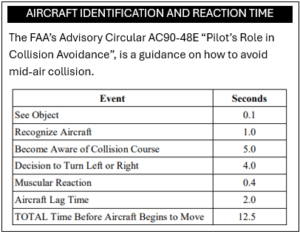
*Source: FAA Advisory Circular 90-48E – Pilots’ Role in Collision Avoidance
The Big Sky Theory

⚠️ If you only see another aircraft when it’s 10–12 seconds away, you may already be out of options. This is why early detection, and an effective scanning discipline are critical in the circuit.
Practical Techniques
✅ Complete checklists early
✅ Structured scanning (Use short, overlapping 10°–15° eye movements)
✅ Understand visual limits (Haze, glare, dirty windscreens, or background clutter)
✅ Anticipate others
💡 Ask yourself: Am I scanning and planning in a way that helps me see, understand, and predict the traffic picture before it becomes a conflict?
Circuit Predictability
The circuit works best when everyone plays by the same rules. Standard patterns give predictability, and predictability keeps traffic safe and flowing. Deviating from published or expected procedures without good reason introduces confusion, especially at busy aerodromes.
👉 CASA Non-Controlled Aerodrome Circuit Procedures
💡 Ask yourself: Am I flying the circuit in a way that helps others anticipate my next move?

Clear Communications
We touched on this topic in Week 2, but it becomes critical here. During approach and landing, communication is about both broadcasting your intentions and understanding others’ intentions. A clear, timely call helps establish sequence, avoid conflict, and keep workloads manageable. At this stage of flight, small delays in communication can lead to big consequences.
👉 Calls are not just about compliance – they set the rhythm of the circuit.
- Be specific: State your aircraft type, position, and intentions.
- Listen actively: Understanding others’ calls is just as important as making your own.
- Avoid surprises: Announce non-standard procedures (e.g. straight-in approach) clearly and early.
💡 Ask yourself: If another pilot hears my call on approach, do they know exactly where I am, what I intend to do, and how that affects their landing plan?
Establishing the Sequence
At non-controlled aerodromes, sequencing relies on pilot-to-pilot coordination. Without a control tower to direct the flow, it’s up to pilots to work together, using clear communication, good judgement, and respect for others, to establish a safe sequence and manage approaches smoothly.
Different types of approaches
Not all approaches look the same, and this is where conflicts can sneak in:
- Straight-ins: Can be efficient but only if announced clearly and early, so others have time to plan around you.
- Short approaches: Reduce spacing but leave little time to stabilise; they demand extra discipline.
- Long finals: Provide more time to settle the aircraft but can catch others by surprise if not broadcasted well in advance.
💡 Whatever your choice is, the golden rule is make it predictable for everyone else.
Mixed performance aircraft
In the same circuit, you might see a high-performance RPT, a slow ultralight, or a helicopter all trying to land. These differences in speed and approach profile can easily create conflicts. Anticipating aircraft performances and adjusting your own spacing is part of good airmanship.
Plan for the unexpected
Even the best-planned approach can unravel. A late-turning aircraft, a missed call, or unstable airspeed on final can all throw things off. That’s why every pilot should be mentally ready for a go-around. Announcing it clearly removes doubt and gives everyone else time to re-adjust.
👉 Establish the sequence early. Keep your approach predictable. And if parameter is not right, go around. That single decision could prevent a close call or accident.
Loss of Control in Flight (LOC-I)
Every approach and landing carries risk – but when the approach becomes unstable, LOC-I events become very real. RAAus’ 3-video LOC-I series vividly shows how small misjudgements (speed, configuration, rate of descent or delays in decision-making) can escalate quickly. Watching these videos can help you recognise similar warning signs before you reach short final.
Warning Signs
⚠️ Flying too fast or too slow
⚠️ Getting behind the aircraft (late turns, poor alignment)
⚠️ Letting expectations override reality
(I’ll make it even though I’m high / downwind / late)
⚠️ Unstabilised approaches from wind, turbulence, or distractions
Good Practices
✅ Stabilise early
✅ Commit to go-around
✅ Learn through reflection
✅ Practice in training


Closing Thought
Approach and landing bring together everything we’ve covered so far: planning, communication, situational awareness, and discipline. By respecting circuit procedures, keeping our calls clear, and committing to a stabilised approach, we set ourselves and everyone else in the circuit up for a safe arrival.
“A safe landing does not begin on short final — it starts with good circuit discipline, clear communication, and staying ahead of the aircraft all the way down.”
PARTICIPATE TO WIN!
Complete the short quiz to enter our Week 4 prize draw!
YOU COULD WIN THE FOLLOWING PRIZE*
FIRST PRIZE: AVIATION SMS COURSE
Sponsored by Southpac Aerospace
Valued at $2,995