
Imagine you’re enjoying a flight on a beautiful, clear, sunny day after hiring an aircraft from your local aero club. Flying straight and level, you suddenly feel a shudder through the airframe.
That’s odd. Perhaps it was a gust of wind or a bit of turbulence.
Then it happens again.
Something doesn’t feel right, so you decide to turn back towards the aerodrome. Shortly afterwards, the engine power begins to decrease.
This isn’t good.
Suddenly, your training kicks in. Fuel pump on. Change tanks.
The engine fires back to life.
Relieved, you land safely and begin trying to work out what happened. A fuel check reveals the right tank is empty.
How could that be?
You carried out a thorough pre-flight inspection and dipped both tanks. The dipstick showed 25 litres in each tank.
This scenario recently happened to one of our members. What started as a perfectly normal flight on a clear day nearly resulted in a forced landing. Fortunately, the situation was recovered safely, but it could have been avoided entirely.
So what went wrong?
The answer is simple: the dipstick.
In this case, the member used a wooden dipstick that had been with the aircraft for many years. Over time, a darker stain had developed around the 25-litre mark, creating the impression that the fuel level had reached that point. Trusting the reading, and with the bright sunlight making it difficult to see inside the tank, the member departed believing there was sufficient fuel onboard.
Thankfully, when the engine began losing power, the member followed the correct troubleshooting procedures and switched fuel tanks, restoring engine operation and allowing for a safe landing.
Problems with older dipsticks are not uncommon. The ATSB recently reported a fuel exhaustion occurrence involving a Cessna 172 in Victoria, where pilots were using a dipstick that was not correctly calibrated for the aircraft. The dipstick indicated approximately 80 litres of fuel when, in reality, less than 20 litres remained.
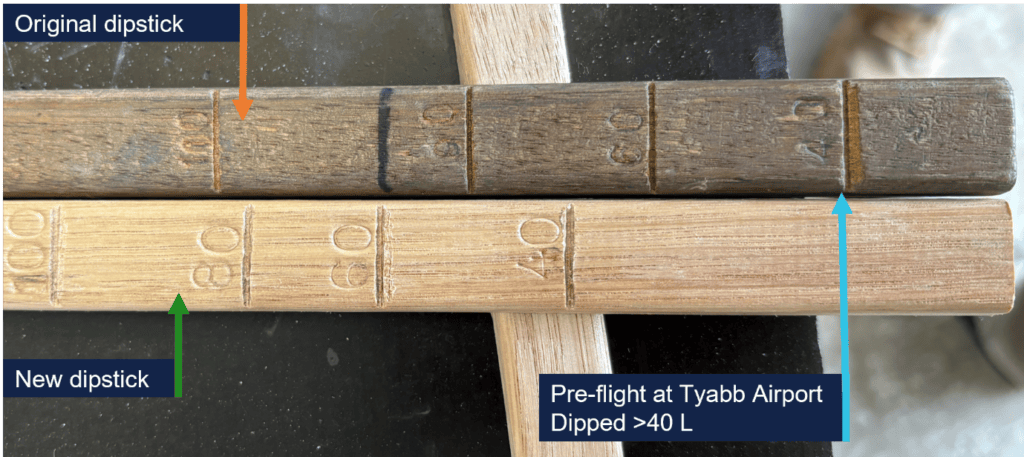
A fuel dipstick should never be the sole method of determining the fuel onboard. Older dipsticks can be difficult to interpret and may provide misleading indications if damaged, worn, stained, or incorrectly calibrated. Always cross-check fuel quantities using all available sources, including aircraft fuel gauges, fuel records, and previous flight times.
For example, if an aircraft has recently completed a lengthy cross-country flight and has not been refuelled since, it is reasonable to expect that additional fuel may be required before your flight, regardless of what the dipstick appears to show.
As the old aviation saying goes:
“The three most useless things in aviation are the sky above you, the runway behind you, and the air in your fuel tanks.”
A few extra minutes spent verifying your fuel quantity before departure could prevent a potentially serious incident.